


A new coronavirus sub-variant, called the “son of Omicron”, may result in more serious illness than the original strain, research shows.
The Japanese study, which has not yet been peer reviewed, found the risk posed by the sub-variant - BA.2 - was “potentially higher” than that of Omicron, otherwise known as BA.1.
The authors reported that cell culture experiments show BA.2 is more “replicative in human nasal epithelial cells and more fusogenic” than BA.1.
Studies in hamsters suggest it is more pathogenic, meaning it causes worse disease.
University of Tokyo
“Neutralisation experiments show that the vaccine-induced humoral immunity fails to function against BA.2 like BA.1, and notably, the antigenicity of BA.2 is different from BA.1,” wrote the researchers, who are from several Japanese institutions, including the University of Tokyo.
“Cell culture experiments show that BA.2 is more replicative in human nasal epithelial cells and more fusogenic than BA.1.
“Furthermore, infection experiments using hamsters show that BA.2 is more pathogenic than BA.1.
"Our multi-scale investigations suggest that the risk of BA.2 for global health is potentially higher than that of BA.1.”
Paul Hunter, professor in medicine at the University of East Anglia, said the research suggests BA.2 grows more rapidly in nasal cells than BA.1, which may explain increased transmission, as infected people could shed more virus particles.
And the study appears to show that BA.2 could be "intrinsically more virulent", he said.
That means it is "more likely to cause severe disease than BA.1, and similar to ancestral variant B1.1, so maybe not as intrinsically virulent as the Delta variant".
"But that doesn’t mean it will necessarily end up causing particularly severe disease in humans," he said.
"The severity of any infection is a balance between the virulence of the virus and our prior immunity.
"So, in people who are triple vaccinated or have been vaccinated and had Covid, especially more than once, may still expect to have less severe disease than we saw in the Delta or prior waves."
The sub-variant is taking over from Omicron in many areas and is already dominant in nations as far apart as India, South Africa and Denmark.
Rise of 'stealth' Omicron
Although technically of the same lineage, BA.1 and BA.2 are 20 mutations apart.
Some believe the sub-variant should have its own Greek letter - in line with the classification of Covid-19 variants - due to the large number of differences it has from the original Omicron.
Kei Sato, a researcher at the University of Tokyo who conducted the study, told CNN the findings from their study prove that BA.2 should not be considered a sub-variant.
"As you may know, BA.2 is called 'stealth Omicron,’" he said.
“That's because it doesn't show up on PCR tests as an S-gene target failure the way Omicron does.
"Labs therefore have to take an extra step and sequence the virus to find this variant.
"Establishing a method to detect BA.2 specifically would be the first thing many countries need to do.”
-
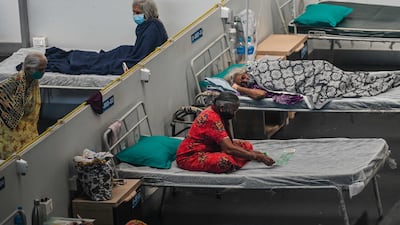
Patients rest inside a Covid-19 isolation centre in Navi Mumbai, India. AFP -

An Israeli paramedic collects a swab sample from a child at a Covid-19 testing centre in Jerusalem. AFP -
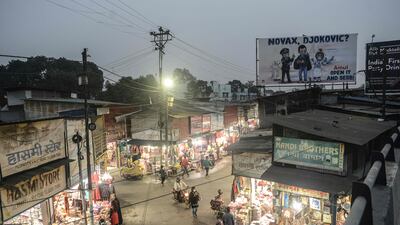
A caricature of Serbian tennis champion Novak Djokovic looks over a market in the Indian city of Siliguri, a day after a court overturned the Australian government's decision to cancel his visa on Covid-19 vaccination grounds. AFP -
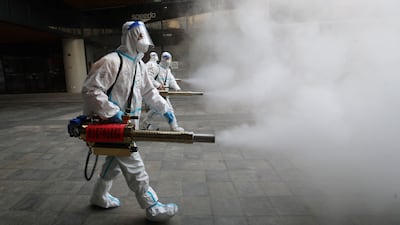
Workers spray disinfectant outside a shopping mall in Xi'an, northern China. AFP -
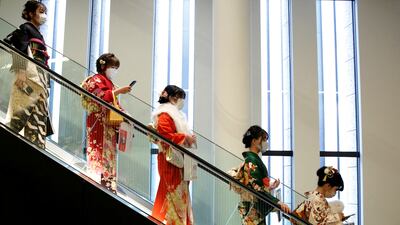
Women wearing kimonos and protective masks ride on an escalator in Tokyo. Reuters -

Dr Anthony Fauci speaks during a US Senate committee hearing to examine the federal response to Covid-19. AP -
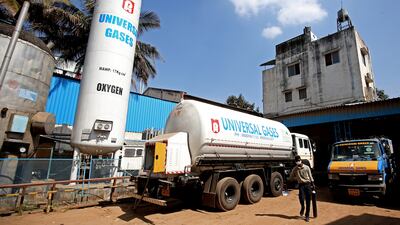
A centre for filling oxygen tanks in Bangalore, India. EPA -

Medical staff dressed in superhero costumes accompany children aged 6 to 11 as they receive a vaccine at a school in Yogyakarta, Indonesia. AFP -

A shopper walks past empty frozen-food coolers at a shop in Cranberry Township, Pennsylvania. Shortages at US shops have grown in recent weeks amid supply-chain struggles and labour issues. AP -
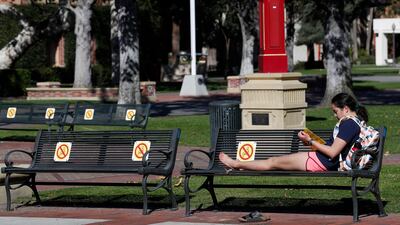
Students and staff at the University of Southern California are required to get Covid-19 vaccine booster shots and show proof of a negative test to return to in-person classes. EPA -
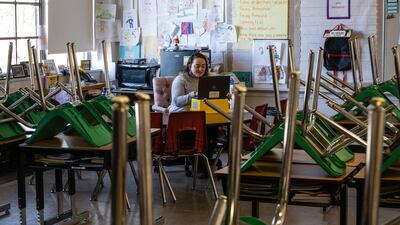
A teacher takes a class remotely at Hazelwood Elementary School in Louisville, Kentucky. Getty -
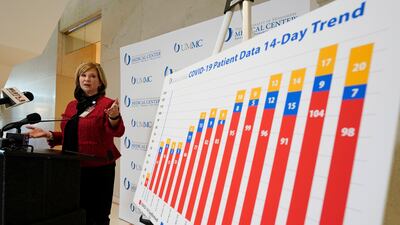
Dr LouAnn Woodward of the University of Mississippi refers to a graph outlining the rising number of Covid-19 patients over a 14-day period. AP -
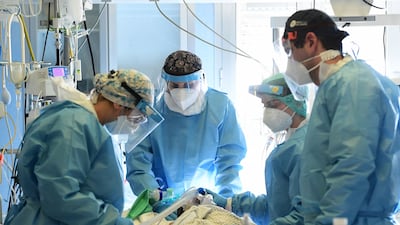
Medics tend to a Covid-19 patient at the intensive care unit of Cremona Hospital in northern Italy. AFP -

Pharmacy workers remove Christmas decorations from a window in Lisbon, Portugal. While Portugal has been reporting record figures of daily new coronavirus cases driven by the Omicron variant, the number of patients in intensive-care units has fallen. Bloomberg -
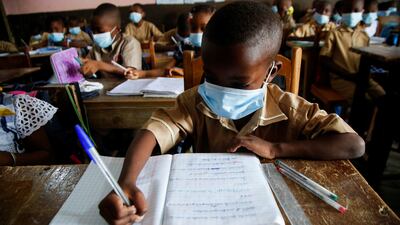
Students wearing protective masks study in a classroom at the Merlan school in Paillet, Ivory Coast. Reuters -
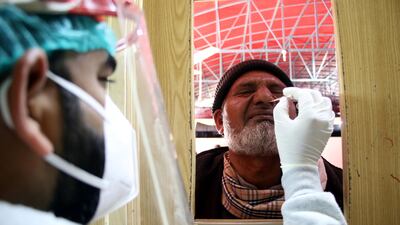
A Pakistani health worker takes a sample to test for Covid-19 during a surge in Omicron cases in Islamabad. EPA -

A general view of the Nightingale Covid-19 Surge Hub which is being erected at the Royal Preston Hospital in Preston, England. Getty -
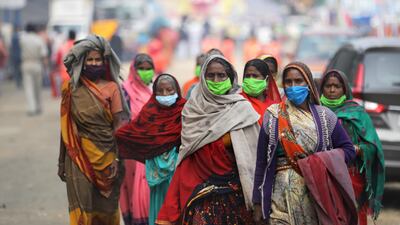
Indian devotees walk for a health check-up at the Babughat transit camp before the Ganga Sagar annual fair in Kolkata, eastern India. EPA


Research shows the new sub-variant is about 30 to 50 per cent more contagious than the original Omicron strain.
But evidence from the real world is mixed on its severity.
A report from the UK Health Security Agency said that “a preliminary assessment” did not find that vaccines were less effective at preventing BA.2 from causing symptomatic disease, compared to BA.1. Hospital admissions in the UK are on the decline.
Another study in South Africa also recently found the new sub-variant did not make people sicker than the original.
However, researchers did caution the findings may not be replicated elsewhere as most immunity in South Africa is the result of natural infections, compared to Europe, where it comes from vaccination.
Natural immunity could hypothetically provide better protection against it, they said.
In Denmark, where BA.2 is overwhelmingly dominant, hospital admissions and deaths are rising.
"Looking at the recent data from Denmark, it is not obvious that case fatality rates there are rising because of the increasing dominance of BA.2 but it is still a bit early days to be sure," said Dr Hunter.
Maria Van Kerkhove, WHO’s technical lead for Covid-19, said while most sequences are still the original Omicron, BA.2 is increasing.
The sub-variant now accounts for about one in every five new Covid-19 cases.
She said there was no evidence that the sub-variant is more lethal than Omicron, but they were monitoring its development.
The original Omicron strain should not be considered a mild infection, she added.
“We are still seeing significant numbers of hospitalisations of Omicron. We are seeing significant numbers of deaths. It is not the common cold; it is not influenza," she said.
“We just have to be really careful right now.”

